ALBUM 4 - 104 SIG SQN
Click on Picture to
view full size
|

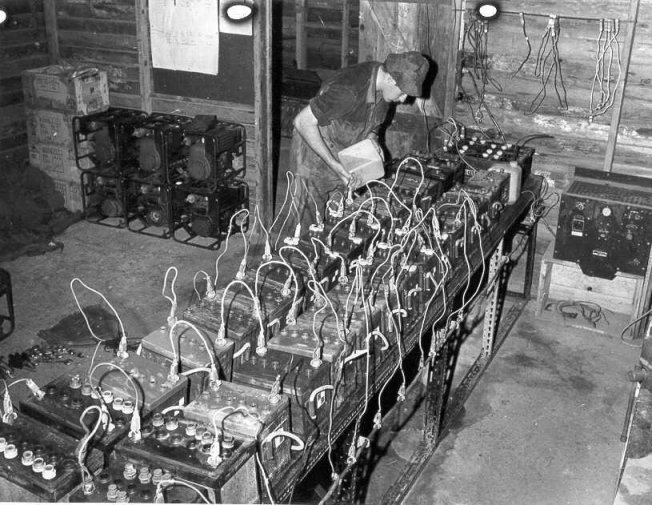
4-1. Mark Howie charging batteries. The 24
volt batteries powered the Command Net Radio Sets housed in the bunkers
and Radio vehicles. Photo supplied by Ken Mackenzie. [1971]
|

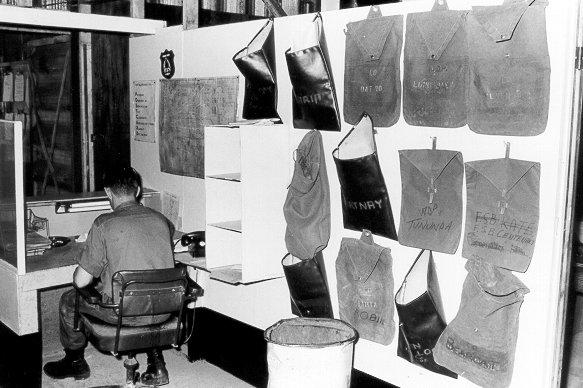
4-2. COMMCEN reception area with Allan
Thackeray manning 'Out Clerks' desk and Patrick Phillips at the 'SDS'
desk. Photo supplied by Ken Mackenzie. [1971]
SDS =
Special Delivey Service.
COMMCEN or COMCEN = Communications Centre
|
|

4-3. COMCEN. Manned by ? Photo supplied by
Ken Mackenzie. [1971]
Note:
The 104 Sig
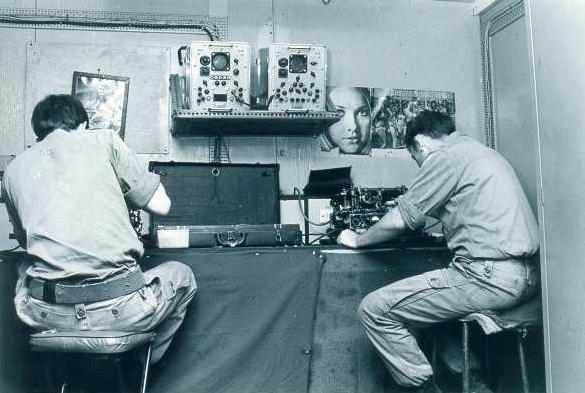
Sqn 1 ATF COMCEN was the hub of communications for the Task Force. The
COMCEN handled all Telegraph Messages from other HQ's and Australia (via
110 Sig Sqn in Vung Tau and Saigon), all formal written messages between
units, the telephone system (Ebony Switchboard) and the delivery of
messages to units using SDS and ADS. The Telegraph equipment was not
computerized and normally operated at 50 bauds. The Telephone System was
manual. The COMCEN was manned 24 hours a day, 7 days a week. COMCEN
facilities were also deployed forward to FSPB's, when required.
|

4-4. Brian (Sharky) Gill at 'IN and Routing
Clerks' desk in the COMCEN. Photo supplied by Ken Mackenzie. [1971]
Note:
The ADS bags
hanging on the wall. Air was the only means by which we could deliver
messages in our AO outside of Nui Dat, securely, safely and quickly.
Note the bag names - BEARCAT (We normally had a radio retrans detachment
at the base) - FSB ROBIN (GR YS435575) - FSB CENTENARY (GR YS661679) - FSB
KATE (GR YS422883) - TUNUNDA (?)
AO = Area
of Operation
ADS = Aerial Delivery Service
FSB (or FSPB) = Fire Support Base (Fire Support Patrol Base)
|
|

4-5. Brian Duncan manning the COMMS CON bunker located beside SQN HQ.
This bunker was dug in late 1968 with three and a half feet of OHP. It
operated as the Sqn CP during emergencies and 'Stand-To's. It also was
equipped to mirror the Radio bunker on Nui Dat hill. Photo supplied by
Ken Mackenzie. [1971]
HQ =
Headquarters
SQN = Squadron (104)
OHP = Overhead Protection
CP = Command Post
COMMS CON = Communications Control
|

4-6. Denis (Shorty) Boland manning COMMS
CON. COMMS CON everyday working role was to monitor and report security
breaches across the 1ATF VHF radio networks. The office was located in
the Sqn HQ building and entry to the COMMS CON bunker was via steps (many)
from this office. Photo supplied by Ken Mackenzie. [1971]
COMMS CON =
Communications Control
1ATF = 1st Australian Task Force
VHF = Very High Frequency
|
|

4-7. Inside the Radio bunker on Nui Dat
hill. The bunker is manned by Raymond (Ray) Jenkin. Photo supplied by
Ken Mackenzie. [1971]
Note:
The unit was
responsible for radio communications from Task Force Units to the Task
Force Headquarters at Nui Dat. Therefore Radio Operators and equipment
was detached to the deployed combat units (Infantry, Engineers, Armour,
Aviation, etc), FSPB's and Liaison Officer Teams located with other
Allied Forces (US Army, Marines, RTAF, ARVN, etc).
|

4-8. 104 Sig Sqn Orderly room (rear of Sqn HQ
building). From left Lawrence Harbridge (Chief Clerk), Alan Moloney, Peter
Rowe, ? Photo supplied by Ken Mackenzie. [1971]
ARVN = Army of the Republic of
Vietnam
|
|

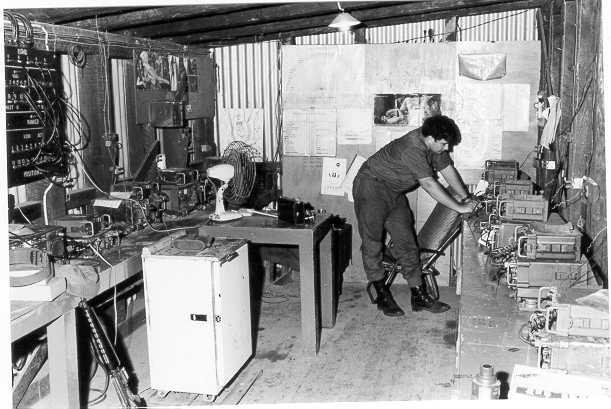
4-9. Telegraph (TG) Mechanics workshop
inside the COMCEN. Laurence Hart and Edward Edwards are the two guys hard
at work. Photo supplied by Ken Mackenzie. [1971]
|

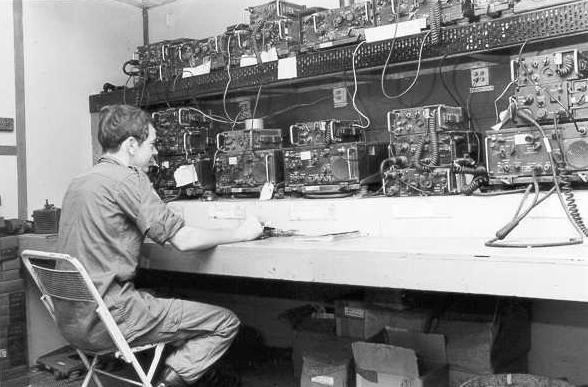
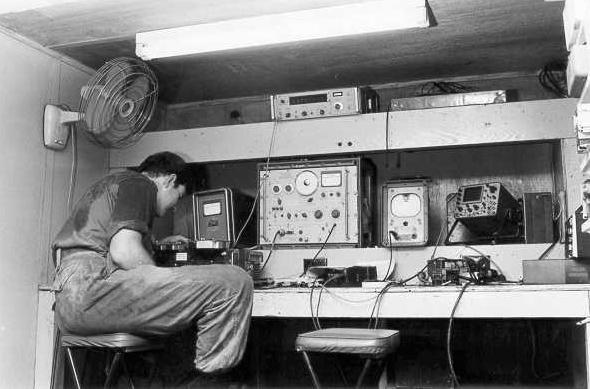
4-10. Mark Howie at the radio repair bench
inside Technical Maintenance (Tech Maint). Photo supplied by Ken
Mackenzie. [1971]
|
|

4-11. Ebony Sir!
Switchboard manned by (from the front) Anthony Campbell, Anthony Pool and
Peter Smith. The Sqn maintained the 1ATF telephone system and allow
connections to other HQ's. Photo supplied by Ken Mackenzie. [1971]
Note:
Ebony Sir!
"Ebony" was the 1ATF (Nui Dat) switchboard designator. Ebony handled
thousands of telephone calls in a normal day and operated, like most of
the units communications equipment, 24 hours a day, 7 days a week. Ebony
was in the early years of 1ATF based on SB-86 switchboards. These were
later replaced by the AN/MTC-1 switchboard shelter shown above.
|

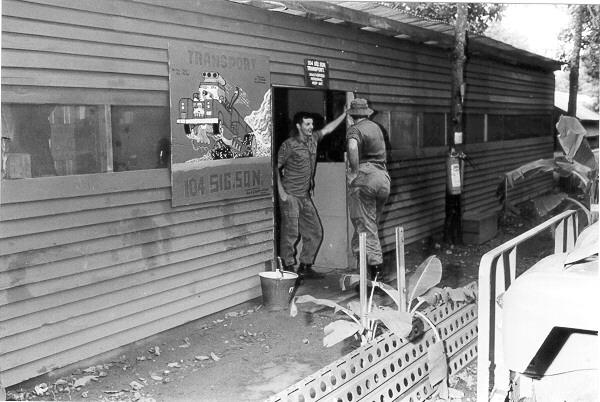
4-12. Graham Mathews and Mark Howie standing
outside the Transport Office. Note the sign changed from the one used in
1968 - same theme however. Photo supplied by Ken Mackenzie. [1971]
|
|

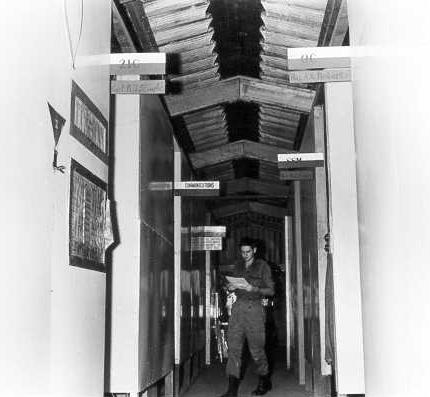
4-13. Looking into Sqn HQ building from the
front with Michael Castle (Admin Officer) in view. Left side first was
Sqn 2IC (Bob Semple) then COMMS CON then Duty NCO. Right side first was
Sqn OC (Tony Roberts) then Sqn SSM (Brian Fisher). Sqn Orderly room was
at the other end of the building. Photo supplied by Ken Mackenzie.
[1971]
Comment:
In 1968 the
walls of the Sqn HQ were never painted. Someone must of located paint and
some poor Digger(s) got the job of painting the walls.
OC =
Officer Commanding
2IC = Second in Command
SSM = Squadron Sergeant Major
NCO = Non Commissioned Officer
Digger = Australian Soldier
|

4-14. HMAS Sydney "The Vung Tau Ferry" off
Vung Tau loading equipment for return to Australia. Sqn members in-bound
for the trip home 6th November 1971. Note the Gunships on the forward
flight deck and the Huey at the rear flight deck pulling pitch. Photo
supplied by Ken Mackenzie. [1971]
Note:
HMAS Sydney
was a WW2 vintage aircraft carrier, use to ferry Australian troops and
equipment to and from the war.
HMAS = Her
Majesty's Australian Ship
|
|

4-15. 104 Sig Sqn members arriving on the
flight deck of HMAS Sydney. The Sqn after 5 years in the war was on its
way home. Ken Mackenzie is stepping out of the Huey (photo right side)
with his gear. Photo supplied by Ken Mackenzie. [1971]
Note:
VC Hill
(Vung Tau) on the horizon left part of photo. Also this photo has the
three Australian Defence Force Services featured. The RAAF, the
ARA and the RAN.
|

4-16. Unit members riding the aircraft
elevator down to the hanger deck for on-board processing and return to
Australia. Photo supplied by Ken Mackenzie. [1971]
RAAF
= Royal Australian Air Force
ARA = Australian Regular Army
RAN = Royal Australian Navy
|
|

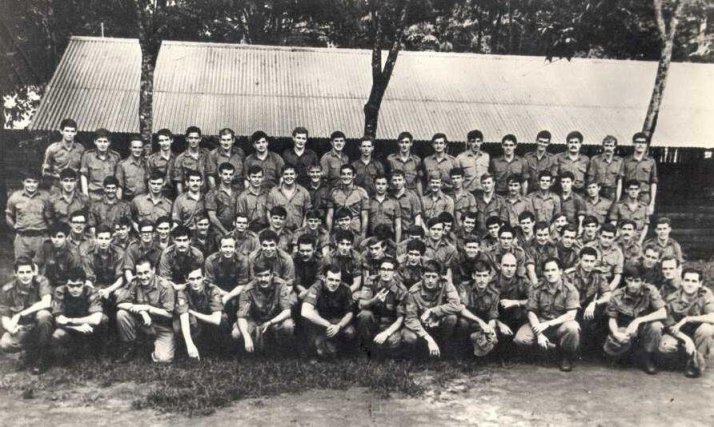
4-17. 104 Sig Sqn group photo of most of the unit members on the 26
August 1971. Photo supplied by Ken Mackenzie. [1971]
|

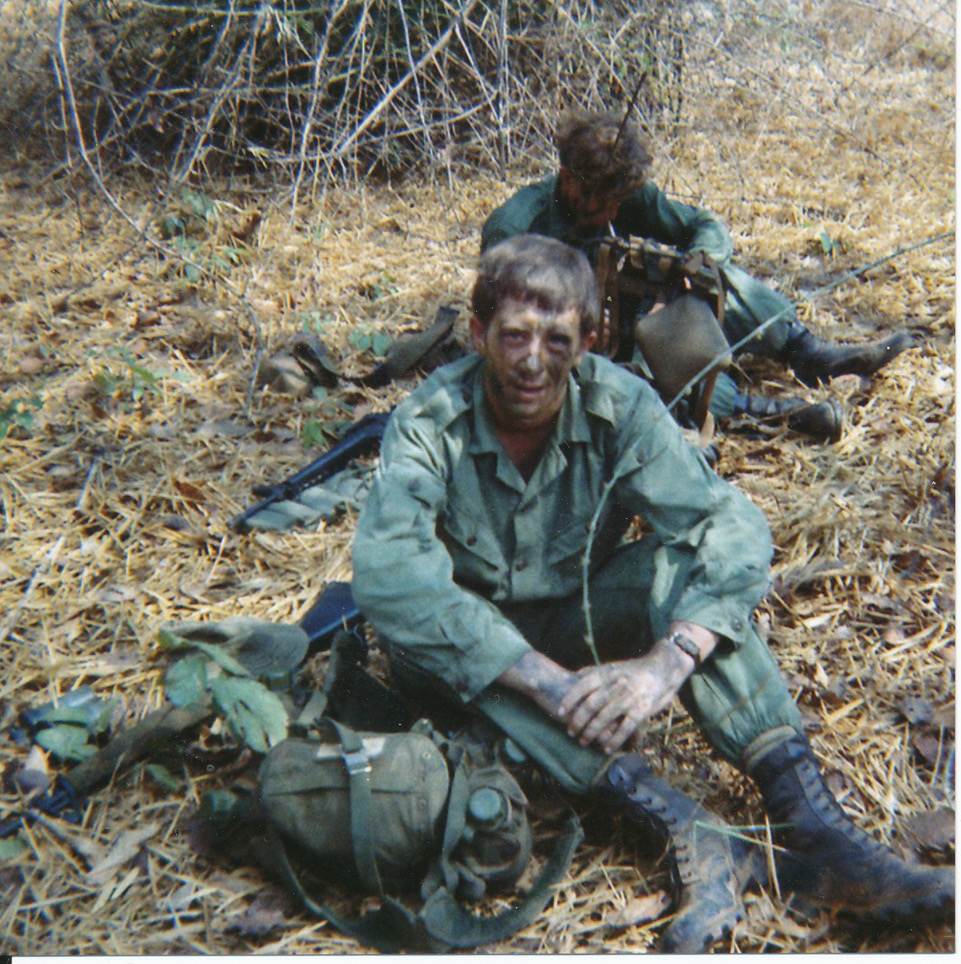
4-18. Ken Mackenzie (front) and Colin (Harry) Sinclair taking a break
in the vicinity of Soui Ca, west of Nui Dat in Feb 1971 on a TAOR Patrol. Photo supplied
by Ken Mackenzie. [1971]
|
Click on Picture
to view full size
|
| Back |
Photo Index |
Next |
| If you would
like copies of some of the photos or can complete some of the missing
names or have photos that I can add to this Web Site, please
email with
details. |